Teaching ethics for substance abuse counseling.
Client: ” I just learned I got Hepititis C. I’m not going to tell my wife because I’d have to admit my affair.”
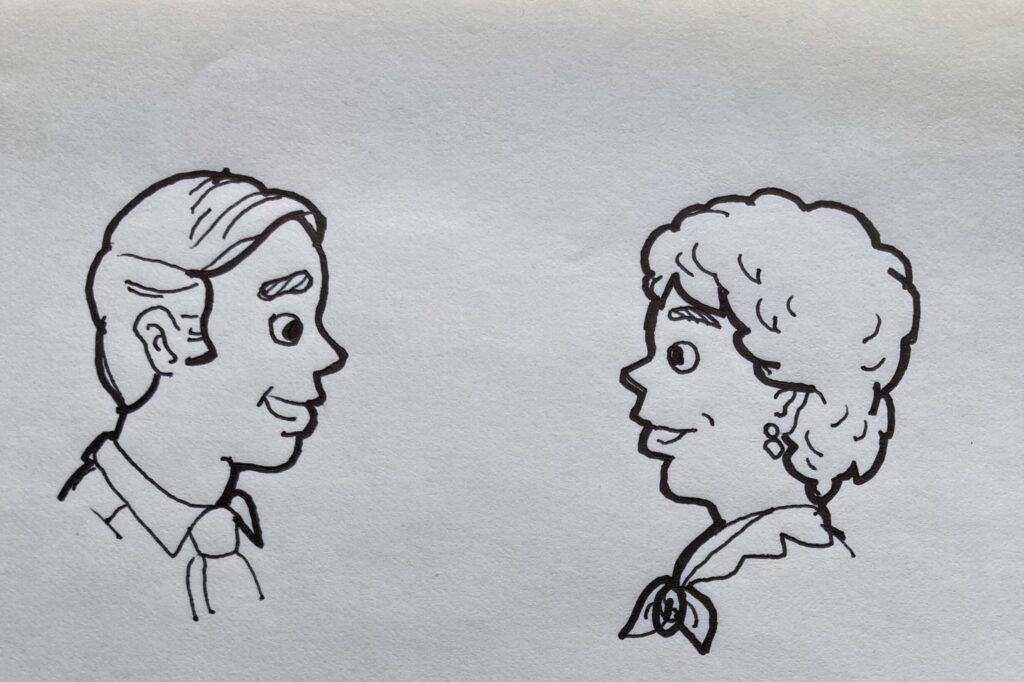
Counselor: (Thinking): “Hmm, what about his wife’s health? What about my client’s deception? How can I bring this up without losing the client????”
I taught ethics for substance abuse counselors at John Jay College for over 25 years. While I tweaked the course each year, the basic approach was always the same. Remarkably, it was never boring, and each group of students brought a different vibe and dynamic to the class. I’d like to pass on the assignments and teaching methods that worked well in my classes.
My main objectives in the course were:
- To have the students learn and understand the CASAC ethical canon.
- To understand the 5 ethical principles.
- To know about the legal issues relevant to counseling.
- To learn to apply a method to think through ethical dilemmas rather than respond intuitively in counseling settings.
Textbook Recommendation
In crafting my course on ethics, I relied on Wefel’s excellent text (Ethics in Counseling and Psychotherapy. Wefel, E.R. 6th ed., 2016) while adding the content specific to substance abuse counseling.
Tip: Use Wefel, any edition, as a good resource for your course on ethics.
Content for for my ethics for substance abuse counseling course
There is a wide array of content areas that must be covered in ethics courses. Some is technical and legalistic. There are also important philosophical and clinical considerations. Here are the content areas I have focussed on:
1. First there are the ethical codes:
- The NAADAC/NCC AP Code of Ethics is comprehensive and covers all of the major ethical considerations for substance abuse counselors.
- State Authority Code of Ethics: Every state substance abuse authority requires credentialed counselors to adhere to a Code of Ethics, usually based on older NAADAC guidelines.
2. There are relevant State and Federal Laws. There is a federal confidentiality law protecting clients in substance abuse treatment. All states have a law which requires counselors to report suspected child abuse and neglect. While not a law, there is a legal requirement to protect the welfare of those who are in danger of harm by clients, known as “duty to warn.”
3. There are the Ethical Principles which guide our ethical decisions:
- Justice
- Non-Maleficence
- Beneficence
- Respect for Autonomy
- Fidelity
4. There are ethical decision-making models. There are a number of models which guide the process of making an ethical decision in counseling settings. I use a modified version of Wefel’s 10 step model (To be posted in the Appendix .)
5. In addition, typical topics covered in most texts on ethics and counseling include discussions of:
- Confidentiality
- Dual Relationships
- Ethical consideration in supervision
- Informed Consent
- Client welfare
- Cultural Diversity
- Competence
- Burnout
- Ethical misconduct
- Social media issues
6. Additional topics I include:
- Crisis counseling and ethics.
- Romantic and sexual feelings between counselors and clients.
- Leading clients to do the right thing.
- Ethical issues regarding client impairment, drug courts, and harm reduction approaches versus abstinence based approaches to counseling.
Tip: Use NAADAC’s Code of Ethics to see the entire scope of ethical issues for addiction counselors.
Teaching methods:
Assignments:
I have used vingettes depicting ethical challenges for substance abuse counselors to engage students to think about ethical issues. Here is an example where the topic is dual relationships:
a. How would you deal with a client giving you a Christmas gift? What issues are involved? Write a script for it.
b. Your client asks you to write a letter of recommendation for a job. You feel he would be a good fit for the job. What issues arise? What would you do? Write a script for it.
c. How would you deal with a client inviting you to his wedding? What issues are involved? Write a script for it.
To help students think about a process of making ethical decisions, I have devised assignments which depict an ethical dilemma and have students use a decision-making model to analyze and think through the dilemma. Here is an example:
The following is a dilemma where client welfare and respect for autonomy are in conflict. Imagine that your client has just told you that they have been assaulted by their partner but does not want to go to the police, does not want to tell anybody, and feels it’s just a one-off and won’t happen again. Using the decision-making model from last week, go through steps in order to find the best solution. Hint: Don’t jump to the solution until the end. Create a dialog with the client to illustrate your answer.
Students can role-play these vignettes as well.
Tip: Use vignettes which illustrate ethical problems and dilemmas that counselors typically face in counseling situations.
There are a couple of concepts that I use throughout the course:
Other than ethical considerations. That is, things like self-interest may conflict with doing the right thing. It is one thing to know in a ideal world what the correct ethical choice, it is another to apply it in real-life situations. For this reason, I believe it is important to point out other considerations which influence our decisions. There are a variety of things that may affect us. Our need for a good evaluation of our supervisor, to be accepted by our colleagues, to keep our jobs, etc. As instructor I do not say as counselors we must be pure. But at least future counselors can include these considerations consciously and decide on their own what they decide to do.
Therapeutic considerations in carrying out ethical decisions. After it’s clear what the right path to take regarding an ethical issue, there still remains the question of how to do it. We want to protect the counseling relationship even if what we have to do may not please our client. Discussing how to implement the solution I believe is a neglected step in discussing ethics for counselors. To take a simple example, if our client is a heavy smoker and has just been diagnosed with a lung disorder, for his welfare, we would advocate for his stopping smoking. But if he wants to continue smoking, how can we therapeutically respond? If we ignore it, he may develop more health problems. If we exhort him to stop, we may alienate him and he may leave treatment. So how we negotiate this challenge is a clinical skill issue as well as an ethical one.
More details of my course are available and will soon be posted in the Appendix. Materials included are lecture notes and assignments.
My attitude toward students in my ethics course over the years.
In my first few years of teaching the ethics course, I focussed on the goal of having students understand the abstract concepts of ethics such as the difference between a problem and a dilemma and understanding ethical principles. Many students were not able to grasp some of these abstract concepts. After some time, I decided that after discussing the concepts, not to belabor them and move on to other topics and just bringing them up as they re-appeared in vignettes about ethical problems. This seemed to work better.
In my first years teaching ethics, I brought an attitude that I could teach what students should do as counselors but they in the end would do what they decided. In part, I had the attitude that I had really little impact on their ethical choices and left me feeling cynical toward the students. In time, I realized that this was a very bad attitude on my part. I began to hear the wish to do the right thing from many of the students and began to have faith that for the most part they wanted to do the right thing. This has fostered a much more positive attitude in the classroom.
Tip: Assume the best of your students to foster a positive atmosphere.
Resources
Text
Ethics in Counseling and Psychotherapy. Wefel, E.R. 6th ed., 2016.
Over the years I have used successive editions of Welfel’s text up through the 6th edition. Her text is highly recommended for completeness, thoughtful consideration of ethical issues, and even-handedness. (But you must add the issues that are specific to substance abuse counseling.)
The 7th edition is now available. Welfel, E.R. and Leach, M.M. 2025. (I have not seen this edition.)
Film
Responding Therapeutically to Patient Expression of Sexual Attraction: A Stimulus Training Tape. American Psychological Association, Norcross, John, 1999. In this video, there are 6 vignettes where experienced and well-trained therapists are confronted with an actor who is role-playing a client expressing sexual interest in the therapist. The scenes are compelling and give students a chance to see experienced therapists deal with this issue.
Website
NAADAC Code of Ethics was revised in 2025 and is now the NAADAC/NCC AP Code of Ethics. This revised Code is comprehensive and can be used as a guide for covering the content for courses on ethics for substance abuse counselors.
Tip: Have students view the film Responding Therapeutically to Patient Expression of Sexual Attraction. It will help them address this challenging situation when it comes up.

This entry is licensed under a Creative Commons Attribution-NonCommercial-ShareAlike 4.0 International license.


Recent Comments